
 Back to List
While Sagapenum may be derived from Ferula galbaniflua, this was also used for coughs, paralysis, hysteria, bronchitis, asthma and to cause uterine contractions according to William Dymock et al. in Pharmacographia Indica, their massive compendium of Indian medicines at the end of the 19th century.
Dymock, William, Warden, C.J.H., Hooper, David. (2005). Pharmacographia Indica A History of the Principal Drugs of Vegetable origin vols 1-3. Srishti Book Distributors. vol 2
Historical: True fennel is Foeniculum – a different genus. In Greek mythology Prometheus stole fire from the gods, hiding it inside a stem of Ferula, and brought it to mankind. Following this the gods put women on the earth! It has little medicinal use, but the sap was called Sagapenum and Henry Lyte (1576) recommends this for epilepsy, joint pain, coughs, breathlessness, stillbirths, poisonous bites and stings, cataracts, and bloodshot eyes.
Lyte, Henry. (1578). Nievve Herball or Historie of Plantes. p.306
A gum 'Gum Ammoniac' is obtained by notching the root. It is used to make incense... The dried pith is used as tinder; it burns very slowly inside the stem and can thus be carried from one place to another.
Plants for a Future (2016) at www.plantsforafuture.org.uk http://www.pfaf.org/user/Plant.aspx?LatinName=Ferula+communis
In Morocco it is known as fessoukh and has been associated with magic and sorcery. Fessoukh means that “which undoes spells (magically)”. It is frequently used in ritual or magic fumigation and in sorcery and counter-sorcery. Fumigation is believed to ward off the “evil spirits”. The roots are also used, especially in a preparation used for hair care.
IUCN, The World Conservation Union. (2005). A Guide to Medicinal Plants of North Africa, IUCN Centre for Mediterranean Cooperation, Malaga (Spain). p.123
Ferula- Giant fennel. The classical Latin name. The word also means the rod used to chastise schoolboys and slaves for minor offences. The giant fennel has tall sticklike stems with a slow-burning pith which enabled Prometheus to bring fire to mankind from heaven.
Stearn, W.T. (1996). Dictionary of Plant Names for Gardeners. Cassell. p.140
communis- common; general; growing in company.
Stearn, W.T. (1996). Dictionary of Plant Names for Gardeners. Cassell. p.101
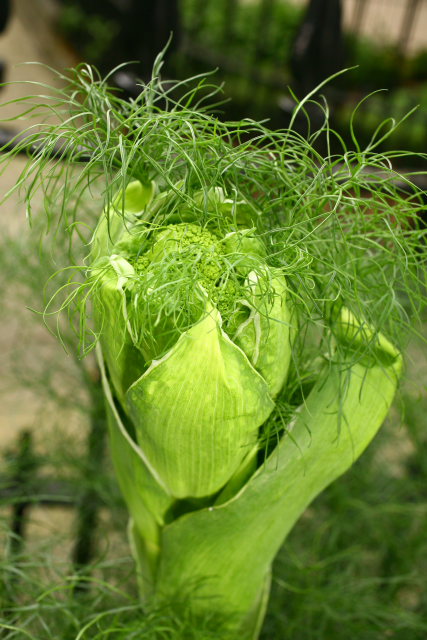
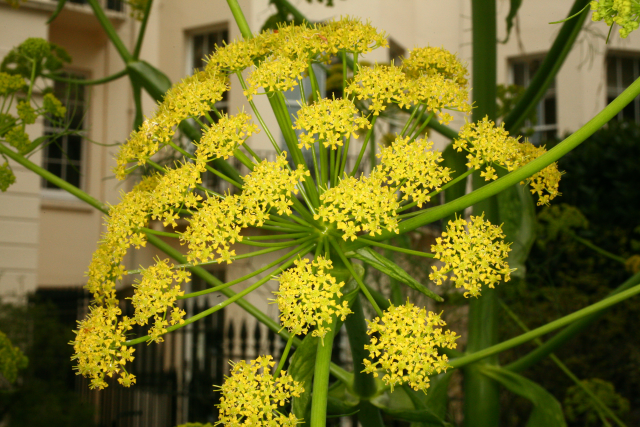
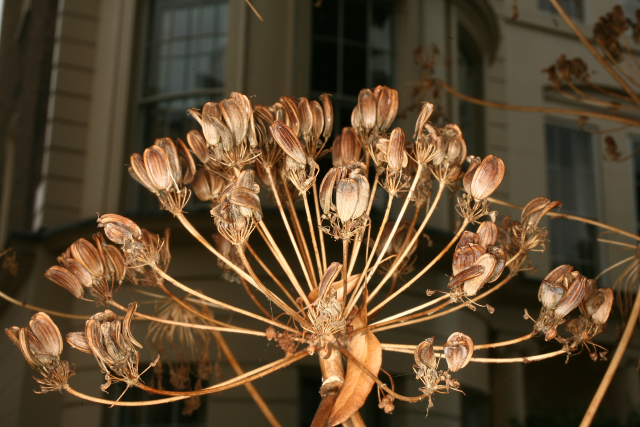
Robust perennial bearing 3-or 4-pinnate leaves, 25-45cm (10-11 inch) long, subdivided into narrow, linear segments. After several years, stout, ridged, branching stems produce clusters of hemispherical, many-branched umbels, 8cm (3in) across, composed of small, 5-petalled yellow flowers. May die after seedling. It grows to 2-3m high by 60cm wide.
Brickell, C. (2003). A-Z Encyclopedia of Garden Plants. Dorling Kindersley. p.448
Grow in fertile, well-drained soil in full sun. To enhance foliage, remove flowering stems as soon as they show, or immediately after blooming if seed is not required. Protect with a dry, bracken mulch in winter.
Brickell, C. (2003). A-Z Encyclopedia of Garden Plants. Dorling Kindersley. p.448
Sow seed as soon as ripe in containers in a cold frame. Prick out seedlings into deep containers to allow tap-root development. Susceptible to aphids, slugs and mildew.
Brickell, C. (2003). A-Z Encyclopedia of Garden Plants. Dorling Kindersley. p.448
Coumarins and daucane sesquiterpenes were identified in solvent extracts of the different parts of Ferula communis. The chemical composition of the essential oil was also investigated. The most important characteristic of Ferrula communis is its capacity to synthesize 4-hydroxycourmarins.
IUCN, The World Conservation Union. (2005). A Guide to Medicinal Plants of North Africa, IUCN Centre for Mediterranean Cooperation, Malaga (Spain). p.122
The young stems and pre-blossom inflorescences of Ferula communis in Morocco are said to have culinary uses. It is sold in medinas as a legume (and called l’boubal). However, a word of caution, as the same chapter goes on to say that the plant is reported to be toxic to humans and livestock. Poisoning depends on the amount of the plant material ingested and the duration of ingestion.
IUCN, The World Conservation Union. (2005). A Guide to Medicinal Plants of North Africa, IUCN Centre for Mediterranean Cooperation, Malaga (Spain). p.122
Europe, Southeastern Europe, Albania
Europe, Southeastern Europe, Bulgaria
Europe, Southeastern Europe, Greece
Europe, Southeastern Europe, Yugoslavia
Europe, Southeastern Europe, Italy
Europe, Southwestern Europe, Spain
Europe, Southwestern Europe, France
Europe, Southwestern Europe, Portugal
Africa, Northern Africa, Algeria
Africa, Northern Africa, Libya
Africa, Northern Africa, Morocco
Africa, Northern Africa, Tunisia
Asia-Temperate, Arabian Peninsula, Yemen
Asia-Temperate, Western Asia, Cyprus
Asia-Temperate, Western Asia, Israel
Asia-Temperate, Western Asia, Jordan
Asia-Temperate, Western Asia, Lebanon-Syria
Asia-Temperate, Western Asia, Turkey
Africa, Northern Africa, Egypt
.JPG)
.JPG)
.JPG)
.JPG)