 Back to List
We grow this the golden-flowered Adonis vernalis, the spring Adonis, in memory of Adonis, the Greek god of plants, who disappeared into the earth in the winter and reappeared in the spring. The flowers were said to have sprung from his blood when he was gored to death by a wild boar, but this plant must have been the blood-red Adonis aestivalis, the summer Adonis. The god’s charges included medicinal plants, we feel he is somewhat of an apothecary.
Oakeley, Dr. Henry. (2012). Doctors in the Medicinal Garden. Plants named after physicians. Royal College of Physicians. Link
Gerard (1633) recommends it for renal stone and intestinal colic, but it is toxic and poisons horses so best avoided.
Oakeley, Dr. Henry F. (2013). Wellcome Library notes. Link
Flos Adonis or Adonides. The red Adonis aestivalis was known as Red Maythes and Red Camomil. (p.386)
Gerard, John. (1975). The Herball or General History of Plants, Dover Publications Inc.. Johnson, Thomas. Facsimile 1633 ed Gardeners' Office library
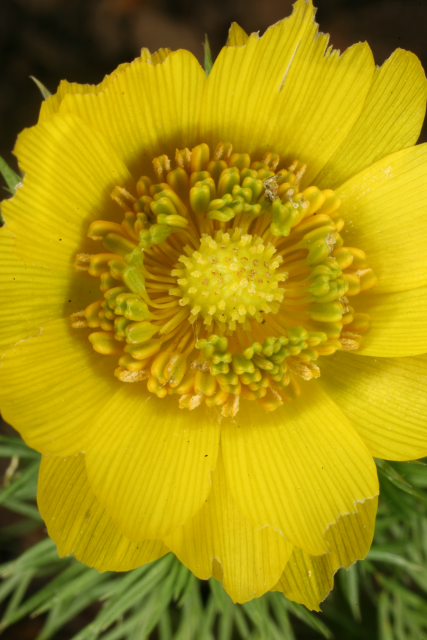
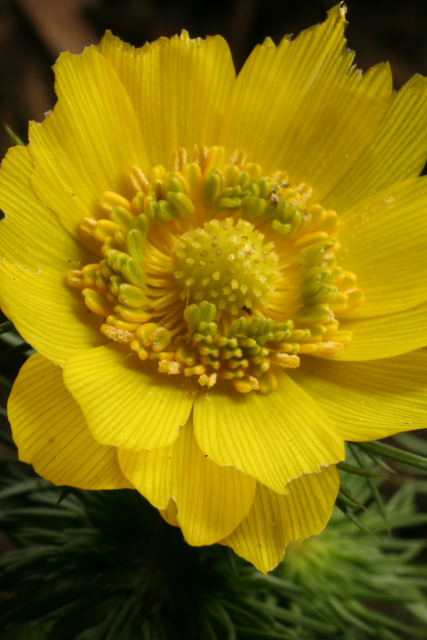
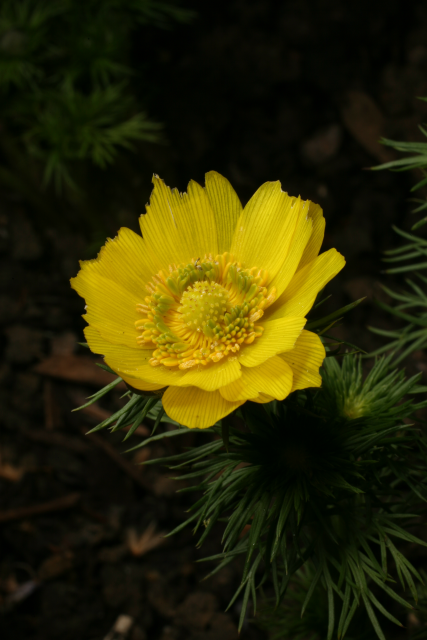
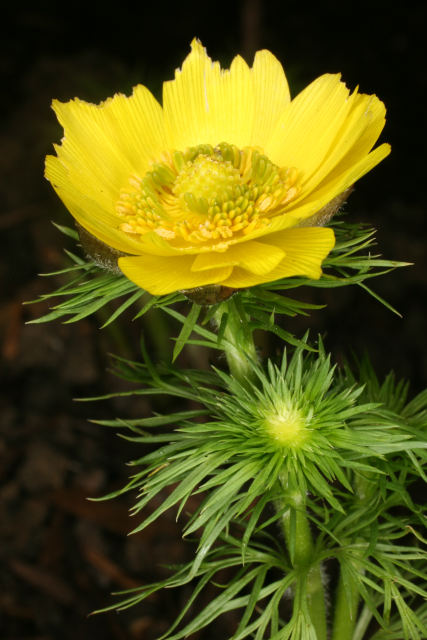
Adonis vernalis is a hardy perennial in the Ranunculaceae family, found on sandy soils in heath, grassland and pine woodlands across Europe. It forms mounds of feathery leaves and striking buttercup-like flowers in spring. It grows happily in the Medicinal Garden at the front of a raised, well-drained border in full sun, with an annual mulch of leaf mould. On planting, the crowns should be a couple of centimetres below the soil surface. Adonis aestivalis is an inhabitant of farmland in southern Europe, North Africa and Asia. It is a pretty, hardy annual with feathery foliage and small, black-centred, red fl owers in early summer. Seed can be sown in shallow drills, in a well-drained sunny border, then thinned out as necessary. Ripe seed can be collected and saved for sowing the following year. [Clare Beacham]
Oakeley, Dr. Henry. (2012). Doctors in the Medicinal Garden. Plants named after physicians. Royal College of Physicians. Link
Not used as toxic.
Active principle: all parts: adonitoxin and other cardiac glycosides (cardenolides).
Wink, M. (2009). Mode of Action and toxicology of plant toxins and poisonous plants. Mitt. Julius Kuhn-Inst. 421:93-111. p.98
Class 1b: Highly hazardous: cardiac glycosides inhibit Na+,K+-ATPase, symptoms of cardiac glycoside poisoning, diuresis, irritation of GI tract with strong diarrhoea, cardiac arrest.
Wink, M. (2009). Mode of Action and toxicology of plant toxins and poisonous plants. Mitt. Julius Kuhn-Inst. 421:93-111. p.98
Asia-Temperate, Caucasus
Asia-Temperate, Siberia
Europe, Northern Europe, Sweden
Europe, Middle Europe, Austria
Europe, Middle Europe, Germany
Europe, Middle Europe, Hungary
Europe, Middle Europe, Poland
Europe, Middle Europe, Slovakia
Europe, Middle Europe, Switzerland
Europe, Eastern Europe, Northwest European Russia
Europe, Eastern Europe, Ukraine
Europe, Southeastern Europe, Bulgaria
Europe, Southeastern Europe, Italy
Europe, Southeastern Europe, Romania
Europe, Southwestern Europe, France
Europe, Southwestern Europe, Spain