
 Back to List
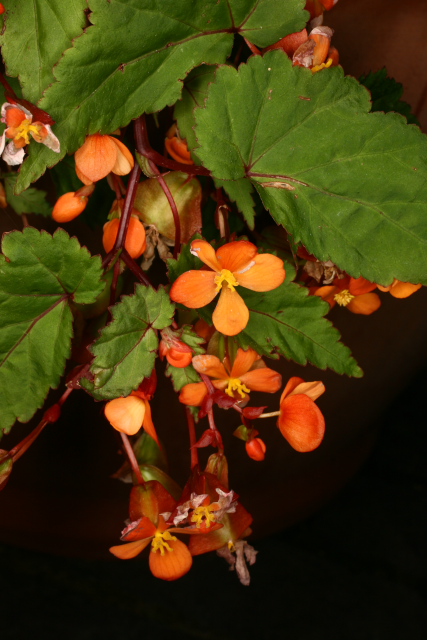
Begonia sutherlandii comes from South Africa and is named after the physician Dr Peter Cormack Sutherland (1822–1900). He was born in Scotland, and studied medicine and geology. In 1850 he was the ship’s surgeon, sailing in HMS Sophia, to discover the fate of Sir John Franklin’s ill-fated expedition (1845) with HMS Erebus and HMS Terror, which had been lost in the Arctic. Frozen into the ice in Assistance Bay to the south of Cornwallis Island in HMS Sophia with her companion ship HMS Lady Franklin and the schooner Felix, they sent out long-distance sledging parties looking for the lost men. They never found Franklin or the ships, only the graves of some of the crew on King William Island. He wrote an account in Journal of a voyage in Baffin’s Bay and Barrow Straits (2 vols, 1852), which included plants collected. He brought back 88 zoological specimens, 26 plants, 80 minerals and 30 fossils, which were deposited at the Royal Navy Hospital Museum at Haslar. He is described as ‘a most indefatigable officer, and his attention while on board to natural history and meteorology will no doubt afford many useful facts’. He also wrote the meteorology and geology section of Sir Edward Inglefield’s A summer search for Sir John Franklin; with a peep into the Polar Basin (1853). Sutherland emigrated to Durban in 1853, where he set up in medical practice, but succeeded to the post of surveyor-general of Natal on the death of William Stanger in 1855. Later, in 1873, he designed a new town, Stanger, which he named after his predecessor. He named a hill, Garden Castle, after his second wife (Jane Garden Blaikie, married 1863). It was written of him that ‘the span of his life was so long and the range of his interests so wide that his biography is virtually the history of Natal’. He was on the Natal legislative council, the first surgeon to the Military Volunteer Corps and chairman of the Natal Medical Committee (1856–96). He was a man of wide interests, from temperance to agriculture, natural history to education, who ‘played a vigorous part in the intellectual atmosphere of the colonial capital’ (Edington, 1963).
Oakeley, Dr. Henry. (2012). Doctors in the Medicinal Garden. Plants named after physicians. Royal College of Physicians. page 73 Link
This Begonia has been given the Award of Garden Merit (AGM) by the Royal Horticultural Society.
Africa, East Tropical Africa, Tanzania
Africa, South Tropical Africa, Malawi
Africa, South Tropical Africa, Mozambique
Africa, South Tropical Africa, Zambia
Africa, South Tropical Africa, Zimbabwe
Africa, Southern Africa, Cape Provinces
Africa, Southern Africa, Free State
Africa, Southern Africa, KwaZulu-Natal
Africa, Southern Africa, Swaziland
Africa, West-Central Tropical Africa, Zaire
.JPG)
.JPG)
.JPG)
.JPG)