
 Back to List
Licensed under the UK Traditional Herbal Remedies legislation. Indication: aid sleep/temporary relief of sleep disturbance.
Medicines and Health Care Regulatory Authority, 2013 Licensed Traditional Herbal Remedies
Valeriana officinalis L. Valerianaceae Valerianus, Phu, Nardus sylvestris, Setwal. Distribution: Europe. Popular herbalism attributes sedation to Valerian, but this is not mentioned by Coles (1657) or Gerard (1633) or Lobel (1576) or Lyte (1578) or Dioscorides (ex Gunther, 1959) or Fuchs (1553), where he quotes Pliny, Dioscorides and Galen, or Parkinson (1640), or Pomet (1712). The English translation of Tournefort (1719-1730) covers a whole page of the uses of all the different valerians, but never mentions sedation or treating anxiety. Quincy (1718) does not mention it. Because it was used in epilepsy, for which Woodville (1792) says it was useless, Haller, in his Historia stirpium indegenarum Helvetae inchoatae (1768) advocates it for those with irritability of the nervous system, as does Thomson's London Dispensatory (1811) although he lists it as an 'antispasmodic and stimulant' and for inducing menstruation. Lindley (1838) notes (as many did) that the roots smell terrible and that this makes cats excited, and in man, in large doses, induces 'scintillations, agitation and even convulsions' so used in asthenic fever, epilepsy, chorea, hysteria and as an antihelminthic.' Fluckiger & Hanbury (1879) give a wonderful account of the history of its names, but give its use as 'stimulant and antispasmodic' as do Barton & Castle (1877). but by 1936 (Martindale's Extra Pharmacopoeia) its only use was 'Given in hysterical and neurotic conditions as a sedative. Its action has been attributed to its unpleasant smell'. The European Medicines Agency (2006) approves its use as a traditional herbal medicine for mild anxiety and sleeplessness for up to 4 weeks. Despite what is written continuously about its use in ancient Greece and Rome, the only reason for its use has been because it was thought, for a brief while, to be good for epilepsy and therefore might deal with persons of a nervous disposition because of its foul smell. It has been suggested that even its Greek name, 'Phu' came from the expression of disgust which is made when one sniffs an unpleasant odour. For 1,800 years, before the last century, no-one had thought it sedative.
Oakeley, Dr. Henry F. (2013). Wellcome Library notes. Link
Notes: The related Red Valerian, Centranthus ruber, was used medically in the past as a sedative for hysteria, anxiety, insomnia, and as an anticonvulsant, and both (as a tea made from the flowers) are used as a sedative in Italy at the present time (Jashemski). The narcotic compounds in the latter are the monoterpene valepotriotes.
Oakeley, Dr. H. F. (2013). The Gardens of the Pharmacopoeia Londinensis.
The major active constituents of Valerian appear to fall into two broad groups: 1 the valepotriates (the main ones are called valtrates), that are non-volatile monoterpenes; and 2 a group of essential oils (volatile compounds), with monoterpenes (mainly bornyl acetate, a type of borneol, with camphene, a type of camphor) and sesquiterpenes (mainly valeric acid) being dominant.
Subhuti Dharmananda, Ph.D., Director, Institute for Traditional Medicine, Portland, Oregon http://www.itmonline.org/arts/valerian.htm
This herb is believed to be the one recorded by Dioscorides as phu, which refers to the peculiar strong odor of the root that combines pleasant and unpleasant fragrances. The herb may have been later named Valerian after the Roman Emperor Valerian (Publius Licinius Valerianus; 253-260 A.D.), or both the herb and Emperor may have been named for their qualities (in Latin, valere means to be in health; valero means to be strong).
Family changed from Valerianaceae to Caprifoliaceae
Plants of the World online, Kew Science http://plantsoftheworldonline.org/taxon/urn:lsid:ipni.org:names:860103-1 Link
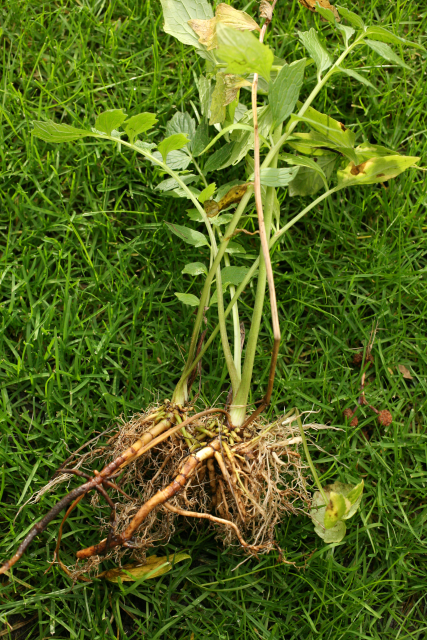
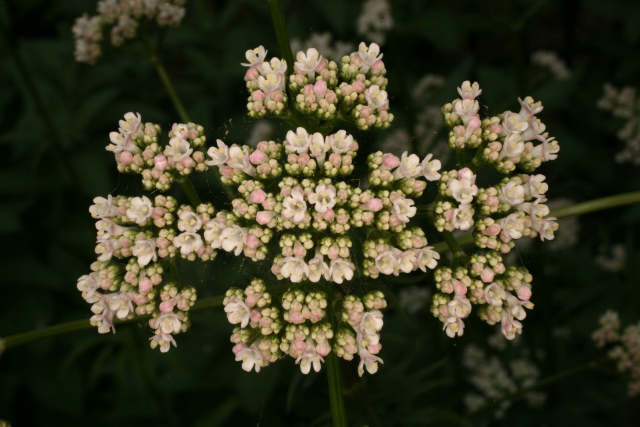
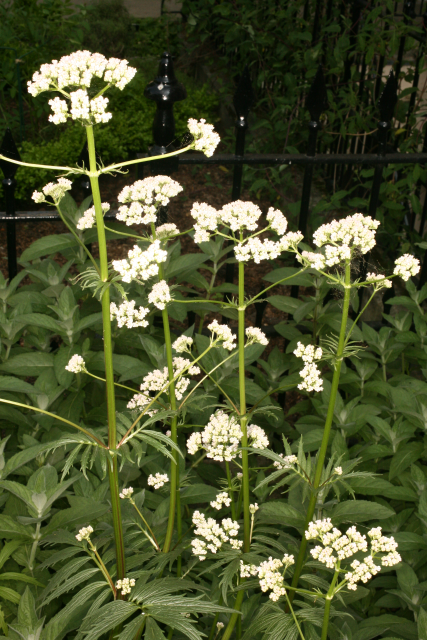
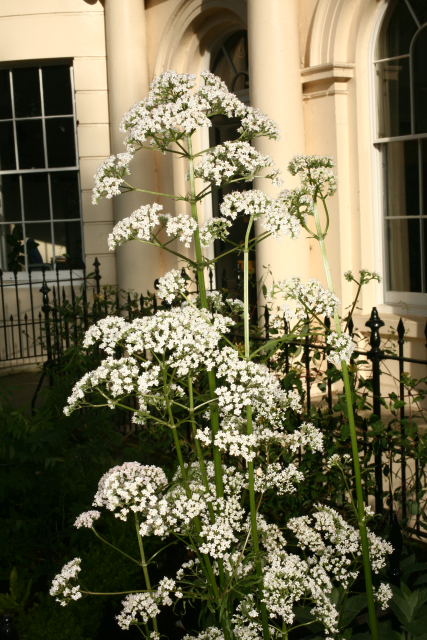
Upright, clump-forming perennial with short rhizomes producing fleshy, branching stems. The aromatic, bright green, basal and stem leaves are pinnate, to 20cm (8in) long, each with 7-10 pairs of lance-shaped, toothed leaflets. Branched, rounded, corymb-like cymes of salverform, bisexual, pink or white flowers, to 5mm long, are borne throughout the summer. Grow in moist soil in full sun or dappled shade. Requires support. We use Hazel pea- sticks. Sow seed in containers outdoors, or take basal cuttings, in spring. Divide in spring or autumn. Pest and disease trouble free.
Brickell, C. (2003). A-Z Encyclopedia of Garden Plants. Dorling Kindersley. p.1066
The herb may have been later named Valerian after the Roman Emperor Valerian (Publius Licinius Valerianus; 253-260 A.D.), or both the herb and Emperor may have been named for their qualities (in Latin, valere means to be in health; valero means to be strong).[HO]
"Hepatotoxicity from valerian is usually mild-to-moderate in severity and self-limiting. Only a small number of cases of liver injury attributed to valerian have been published, and there have been no instances of chronic hepatitis, cirrhosis or vanishing bile duct syndrome attributed to its use, and no convincing case of acute liver failure."
US NIMH Drug record on Valerian (Valeriana officinalis) https://livertox.nlm.nih.gov/Valerian.htm
Toxicity of Sodium valproate in pregnancy: http://www.medicines.org.uk/emc/RMM.420.pdf. Congenital malformations 10% (cleft lip, plate, craniostenosis, cardiac renal, limb defects; and multiple anomalies). Developmental disorders 30-40% (delayed milestones, lower IQ - by -10 poins- , poor language skills, poor memory). Autism is 5 times more likely, autism spectrum disorder 3 times more likely. Also attention deficit disorder.
Important Information .... on the risks of Valproate in female patients http://www.medicines.org.uk/emc/RMM.420.pdf
Side effects/precautions: Hypersensitivity; do not co-medicate; do not take with alcohol; may cause gastrointestinal symptoms. From Patient information leaflet for preparations licensed as Traditional Herbal remedies in the UK
Medicines and Health Care Regulatory Authority, 2013 Licensed Traditional Herbal Remedies
Prescription only medicine: Sodium valproate.
Traditional Herbal Medicine Registration (THMR).
Culpeper: calls it Setwal and writes: ‘see the Roots’ where he lists it by another name: ‘Behen. alb. rub. Of Valerian white and red, Mesue, Serapio and other Arabians say they ... comfort the heart, stir up lust. The Graecians held them ... to stop fluxes and provoke urine.’
Culpeper, Nicholas. (1650). A Physical Directory . London, Peter Cole.
"Valerian is claimed to have sedative, hypnotic, anxiolytic, anticonvulsant, antispasmotic and antidepressant activities. Presently, it is used most commonly as a sleeping aid and for therapy of stress. The basis for its sedative effects is believed to be valepotriates (which are terpene alcohols) and volatile oils (including monoterpenes and sesquiterpenes). Components of valerian are believed to interact with the gamma amino butyric acid (GABA) receptor in a manner similar to the benzodiazepines. The typical dosage of valerian is 300 to 600 mg at bedtime for sleep or taken 3 times daily for stress. Valerian is found in many relaxation drinks. Valerian has few side effects, which are mostly mild and transient and include sedation, dizziness and withdrawal symptoms on stopping." https://livertox.nlm.nih.gov/Valerian.htm for more information.
US NIMH Drug record Valerian (Valeriana officinalis) https://livertox.nlm.nih.gov/Valerian.htm
Sodium ion channel blockade. Contains valeric acid, from which valproic acid and then sodium valproate was synthesised. Latter used for epilepsy, neuropathic pain, mania and for migraine prevention.
Oakeley, Dr. H.F. (2013). Medicines from RCP plants label list 5-2013.docx.
Could Valerian Have Been the First Anticonvulsant? Paper by Mervyn J. Eadie Department of Medicine, University of Queensland, Royal Brisbane Hospital, Brisbane, Australia
https://onlinelibrary.wiley.com https://onlinelibrary.wiley.com/doi/pdf/10.1111/j.0013-9580.2004.27904.x#:~:text=Use%20in%20epilepsy,its%20use%20in%20seizure%20disorders
Asia-Temperate, Western Asia, Iran
Asia-Temperate, Western Asia, Turkey
Asia-Temperate, Caucasus, North Caucasus
Asia-Temperate, Caucasus, Transcaucasus
Asia-Temperate, Siberia
Asia-Temperate, Russian Far East
Asia-Temperate, China
Asia-Temperate, Eastern Asia, Japan
Europe, Northern Europe
Europe, Northern Europe, Great Britain
Europe, Middle Europe
Europe, Eastern Europe
Europe, Southeastern Europe
Europe, Southwestern Europe
.JPG)
.JPG)