 Back to List
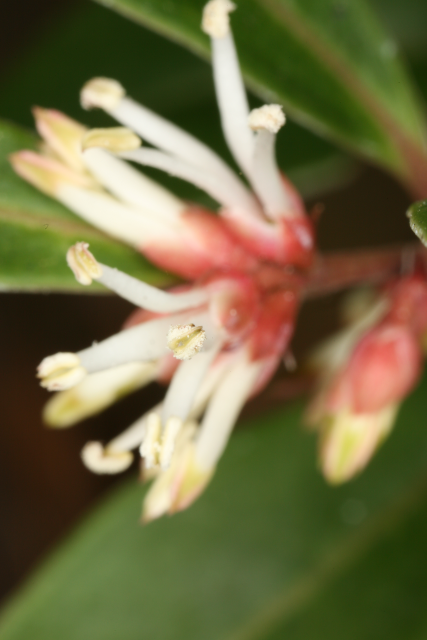
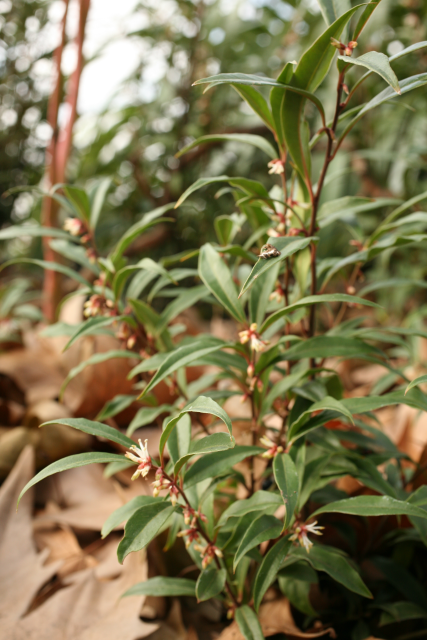
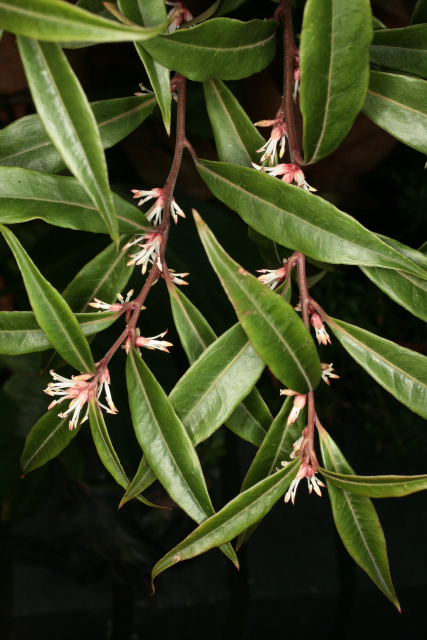
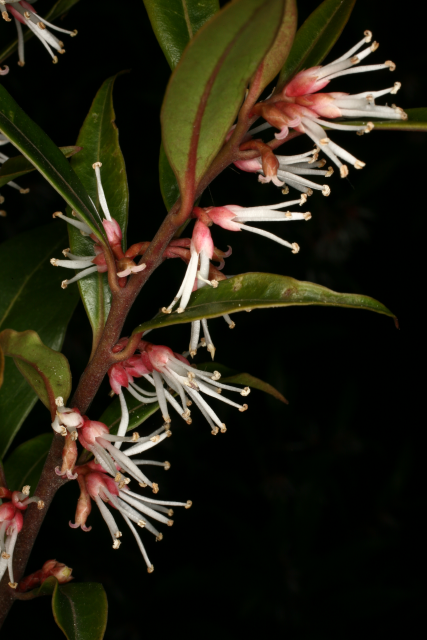
Sarcococca hookeriana Baill. Buxaceae var digyna. This variety has the RHS Award of Garden Merit. Himalayan Sweet Box. Distribution: China to Himalayas. Sarcoccoca means flesh fruit; hookeriana pertains to one of the Hooker's, Directors of the Botanic Garden, Kew - but could be either the father or the son; digyna may be from the Linnaean order of plants, Digynia, meaning 'with two styles' (the stalks that connect the stigma to the ovary). Steroidal alkaloids have been found in the plant which have antileishmaniasis activity in vitro.
Oakeley, Dr. Henry F. (2013). Wellcome Library notes. Link
Sarcoccoca means flesh fruit; hookeriana pertains to one of the Hooker's, Directors of the Botanic Garden, Kew - but could be either the father or the son; digyna may be from the Linnaean order of plants, Digynia, meaning 'with two styles' (the stalks that connect the stigma to the ovary).
Oakeley, Dr. Henry F. (2013). Wellcome Library notes. Link
Steroidal alkaloids have been found in the plant which have antileishmaniasis activity in vitro.
Oakeley, Dr. Henry F. (2013). Wellcome Library notes. Link
The Sarcococca genus (Buxaceae) consists of about 20 species, widely distributed in the southwestern region of China and other south Asian countries [ Editorial Committee of Flora of China . Flora Reipublicae Popularis Sinicae. Volume 45. Science Press; Beijing, China: 2004. pp. 41–56.]. The members of Sarcococca plants are used as TCM and traditional folk medicine for the treatment of stomach pain, rheumatism, swollen sore throat and traumatic injury.
https://www.ncbi.nlm.nih.gov https://www.ncbi.nlm.nih.gov/pmc/articles/PMC6337136/
Named for Sir William Jackson Hooker in 1859. He was then curator at Kew. His son Dr Joseph Dalton Hooker became curator in 1864 after his father's death.
Likes damp conditions and light shade but grows well at the College in dry raised beds. Wonderfully fragrant in January and February
Asia-Temperate, China