
 Back to List
It contains quinones and these may give rise to allergic reactions (MCA, 2002).
Medicines and Health Care Regulatory Agency , MCA. (2002). Medicines and Health Care Regulatory Agency (MHRA) for restricted or prohibited herbal medicines. Medicines and Health Care Regulatory Agency . Link
Lobel (1576) calls them Primula veriflorae, Phlomides, Primula veris, Verbascula. Like other herbals of the 16th and 17th century, the woodcuts leave one in no doubt that Primula veris was being written about. Lyte (1578) calls them Cowslippe, Petie mulleyn, Verbasculum odoratum, Primula veris, Herbae paralysis and Artheticae
Oakeley, Dr. Henry F. (2013). Wellcome Library notes. Link
Cowslips were sometimes known as ‘keyflowers’, suggested by the shape of the flower clusters, which are like a little bunch of keys. In Norse mythology they were dedicated to Freya, giving access to her palace, but in the Christina era became “St Peter’s Keys” or the “Keys of Heaven”. The generic name, Primula, comes from primus, first, in recognition that they are among the earliest flowers of spring. At one time, when they were plentiful, they were gathered in vast quantities to make spring tonics and the gently soporific, pale-yellow cowslip wine. Many medicinal uses were assigned to the flowers and distilled cowslip water was said to be good for the memory. The cosmetic applications were mentioned reprovingly by William Turner: “Some women we find, sprinkle ye floures of cowslip with whyte wine and after still it and wash their faces with that water to drive wrinkles away and to make them fayre in the eyes of the worlde rather than in the eyes of God, Whome they are not afrayd to offend” (The New Herball, 1551).
Bird, R, Houdret, J. (2000). Kitchen and Herb Gardener. Lorenz. p.436
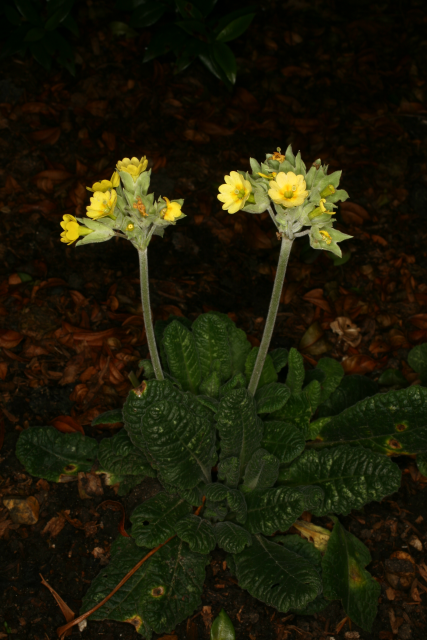
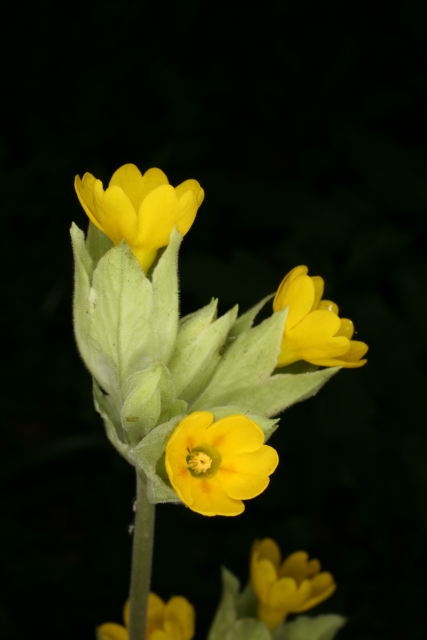
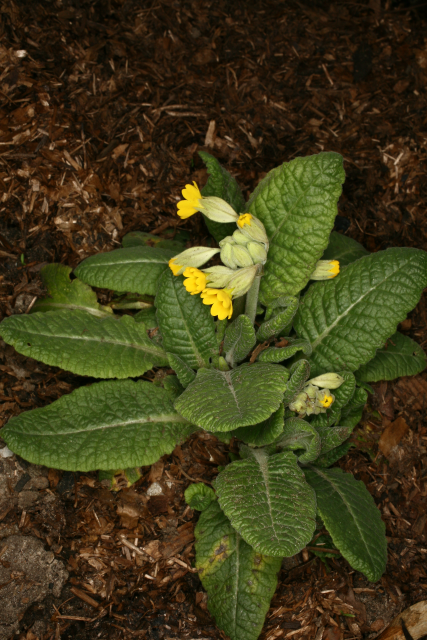
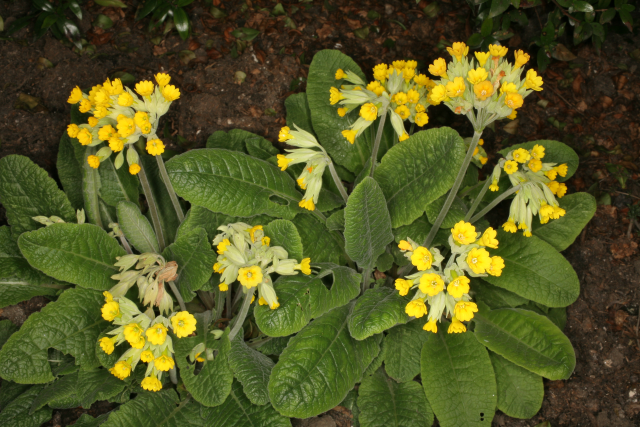
Very variable, rosette-forming, evergreen or semi-evergreen perennial with oblong-ovate to ovate, sometimes scalloped, mid-green, rough- textured leaves, to 20cm (8 inch) long. In mid- to late- spring, flower stems rise above the basal leaves, 15-20cm, and are topped by umbels of 2-16 salverform, nodding, fragrant, deep yellow flowers, 1.5-2.5cm across. 25 cm (10 in) high and wide.
Brickell, C. (2003). A-Z Encyclopedia of Garden Plants. Dorling Kindersley. p.852
Traditional Herbal Medicine Registration (THMR).
Culpeper (1653)“... strengthen the brain, memory, senses, exceedingly, resist all diseases there, as convulsions, falling sickness and palsies, etc.”
Culpeper, Nicholas. (1653). The London Dispensatory.
Cowslips have sedative, expectorant properties and contain salicylates (as in aspirin). They are taken as a tea for insomnia, anxiety, respiratory tract infections and rheumatic disorders. Parts used- Flowers- fresh (but must not be picked from the wild, as they are quite rare).
Bird, R, Houdret, J. (2000). Kitchen and Herb Gardener. Lorenz. p.436
Cowslip wine, a traditional country recipe.
Podlech, D. (1996). Herbs & Healing Plants of Britain & Europe, Collins p.56
Asia-Temperate, Western Asia, Turkey
Asia-Temperate, Western Asia, Iran
Asia-Temperate, Caucasus, Transcaucasus
Europe, Northern Europe, Denmark
Europe, Northern Europe, Finland
Europe, Northern Europe, Ireland
Europe, Northern Europe, Norway
Europe, Northern Europe, Sweden
Europe, Middle Europe, Austria
Europe, Middle Europe, Belgium
Europe, Middle Europe, Czech Republic
Europe, Middle Europe, Germany
Europe, Middle Europe, Hungary
Europe, Middle Europe, Netherlands
Europe, Middle Europe, Poland
Europe, Middle Europe, Switzerland
Europe, Northern Europe, Great Britain
Europe, Southwestern Europe, France
Europe, Southwestern Europe, Spain
Europe, Southeastern Europe, Albania
Europe, Southeastern Europe, Bulgaria
Europe, Southeastern Europe, Greece
Europe, Southeastern Europe, Italy
Europe, Southeastern Europe, Romania
Europe, Southeastern Europe, Yugoslavia
.JPG)